
Why Exclusion Might Be the Smarter Way to Train AI
In the world of AI and machine learning, we’re obsessed with data. More data, cleaner data, more diverse data — all to “feed” our algorithms and teach them to make better decisions.
But what if we looked at the problem from the opposite direction?
What if, instead of constantly adding more data, we started removing it?
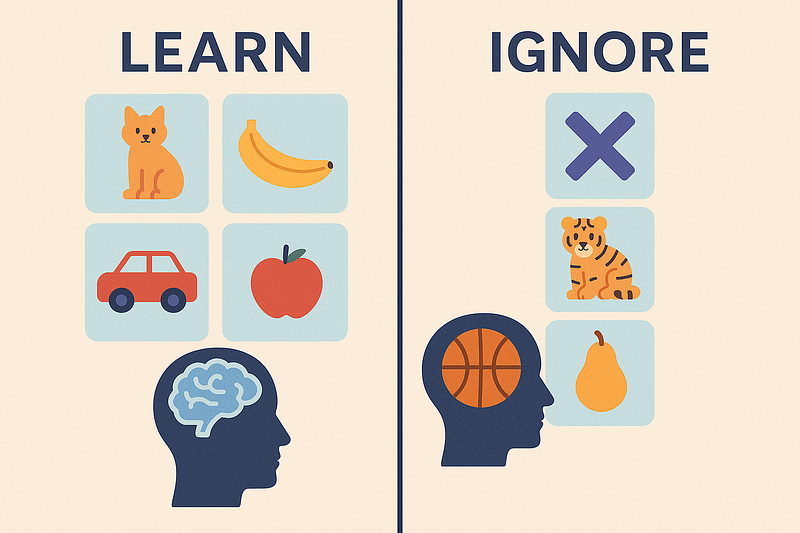
In this article, I explore a counterintuitive idea: that sometimes, the best way to train an AI system isn’t to tell it what to learn — but what not to.
The Problem With Too Much Data
Modern models — especially those based on deep learning — rely on massive datasets with millions or billions of parameters. But more data doesn’t always mean better models.
In fact, too much data can introduce:
- Noise
- Bias
- Irrelevant edge cases
- Unintended behavior
We often train models on everything we can find, then wonder why they behave unexpectedly. It’s not about quantity — it’s about quality and focus.
A Paradigm Shift: Learn by Exclusion
What if we reversed the way we think about training?
Instead of asking “What should the model learn?”
We ask: “What should the model ignore?”
This approach — which I call inverse training or negative signal curation — emphasizes pruning the dataset:
- Removing outliers and noise
- Excluding harmful or biased patterns
- Preventing the model from overfitting on irrelevant examples
Think of it like raising a child: sometimes the most effective lesson is “don’t do this,” rather than listing every correct action.
Real-World Applications
Here’s what exclusion-based learning could look like in practice:
- Computer Vision: Instead of labeling thousands of “not a cat” images, exclude ambiguous edge cases that confuse the model (like small tigers or furry slippers).
- Fraud Detection: Removing false positives is often more effective than flooding the system with more legitimate transactions.
- Language Models: Excluding toxic forums, disinformation, or fringe content improves tone, bias, and safety — without increasing training set size.
The Advantages of Inverse Training
- ✅ Reduces cost of data collection and annotation
- ✅ Increases accuracy by focusing on signal over noise
- ✅ Avoids bias that creeps in through bad examples
- ✅ Simplifies the model, making it more interpretable
In short, inverse training helps models learn better with less.
How It Could Work in Practice
A practical workflow for exclusion-based training might look like:
- Initial training on a focused core dataset
- Identifying harmful outliers through evaluation
- Creating a “negative list” — data to be ignored
- Retraining with tighter, cleaner inputs
This could even become an active learning loop, where the system flags confusing data and you decide what to remove, not just what to add.
Conclusion:
In a world obsessed with big data, maybe the next frontier is smart data.
And smart data sometimes means knowing what not to learn.
So next time you think about improving a model, don’t ask:
“What else can I add?”
Ask instead:
“What should I unteach?”
That might be where true intelligence begin.
Have you ever seen a model perform better with less data? Or a system that got it wrong because it learned something it shouldn’t have?
Share your thoughts in the comments 👇
Thanks for reading — I’m on a journey to understand how AI is reshaping the way we design, build, and think about products.
I write to explore ideas, question assumptions, and spark better conversations.
What’s something this made you reflect on? I’d love to hear your perspective in the comments.
Comments (0)
Loading comments...