
The Great Divorce: Designers Can Code, Developers Can Design — Now What?
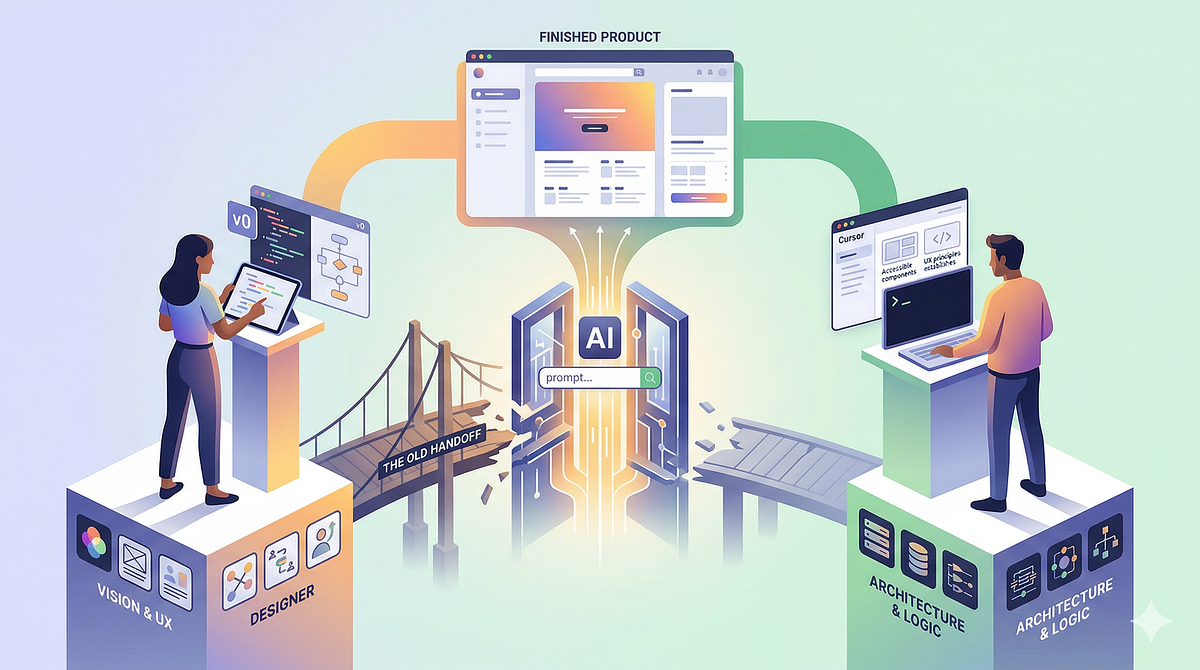
Let’s be honest: the “hand-off” has always been a bit of a theater. For years, we’ve built these elaborate rituals — redlines, documentation, videos — just to bridge the gap between what a designer imagines and what a developer actually builds. It was a friction-filled border crossing, often marked by “that’s not technically possible” or “you missed the padding by 2 pixels.”
Now, the walls are coming down.
With AI tools like v0, Bolt, or Cursor, designers are starting to ship production-ready frontend code. Simultaneously, developers are using LLMs to generate high-fidelity UI that follows established UX patterns without ever opening a Figma file.
The question everyone is asking is: Does this “cool down” the relationship? Are we drifting into silos where we no longer need each other?
From where I sit, it’s not a cooling. It’s an evolution from tactical friction to strategic alignment. But for corporations, the implications are much deeper than just “faster workflows.”
1. The Death of the “Translator” Role
In the pre-AI era, a huge chunk of our value was tied to translation. Designers translated user needs into pixels; developers translated pixels into code. When you automate the translation, you change the job description.
If a designer can prompt a functional prototype into existence, they aren’t just “designing” anymore — they are implementing. If a developer can generate a clean, accessible dashboard layout through an AI agent, they aren’t just “coding” — they are architecting an experience.
The relationship isn’t cooling; it’s being stripped of its low-value noise. We are finally moving away from arguing about hex codes and moving toward a state of Vertical Integration.
The “negotiation” is no longer about how to build a button, but why that button should even exist in the first place.
2. The Corporate Trap: Speed vs. Coherence
At a corporate level, this democratization of execution is a double-edged sword. On paper, it looks like a massive ROI win. Less headcount, faster time-to-market. But there’s a hidden cost: Systemic Debt.
When everyone can “do everything,” the risk of a “Frankenstein Product” skyrockets.
- The Developer-Led Silo: You get an application that is technically robust and fast, but logically frustrating. It lacks the “invisible” UX — the empathy, the edge cases, and the emotional resonance that keeps users coming back.
- The Designer-Led Silo: You get a beautiful, interactive interface that is an architectural nightmare. It’s unscalable, insecure, and breaks the moment you try to integrate it with a complex backend.
For leadership, the challenge isn’t finding people who can “use AI.” It’s building Governance at Scale. In this new world, the Design System is no longer just a library of assets; it becomes the Logical Brain for the AI. If your system is messy, the AI-generated code will be messier.
3. The Rise of the Product Architect
We are seeing the emergence of a new archetype: the Product Architect.
This isn’t someone who just knows how to use Figma or VS Code. This is a professional who operates at the intersection of systems thinking and user psychology.
- Designers must now understand data structures and logic. You can’t prompt a complex intelligent system if you don’t understand how data flows through it.
- Developers must now understand HCI (Human-Computer Interaction) principles. If you’re using AI to generate UI, you need the taste and the critical eye to know when the AI is giving you a “correct” but “bad” experience.
The value has shifted from Execution (which is now a commodity) to Orchestration.
4. Why the Human “Glue” Matters More Than Ever
The relationship isn’t cooling because, ironically, AI makes the human element more critical.
AI is great at the average. It can give you a “good enough” UI and “working” code. But “good enough” is the death of brand loyalty in a crowded market.
The “warmth” in the designer-developer relationship now comes from Shared Strategic Ownership. Instead of fighting over pixels, we are now co-directing a fleet of AI agents. We are curators of quality, guardians of ethics, and architects of trust.
The Bottom Line
In the corporate world of 2026, the “hand-off” is dead. Long live the Unified Build.
If you’re a designer worried that developers won’t need you, or a developer thinking you can skip the design phase — you’re missing the point. AI isn’t a replacement for the other discipline; it’s a tool that forces both of us to level up.
The companies that will win aren’t the ones who use AI to cut people out of the process. They are the ones who use AI to allow their designers and developers to finally stop speaking different languages and start building products with a single, unified vision.
How are you handling this shift? Are you seeing more autonomy in your teams, or is the “quality debt” starting to pile up? Let’s discuss in the comments.
Thanks for reading , I’m on a journey to understand how AI is reshaping the way we design, build, and think about products.
I write to explore ideas, question assumptions, and spark better conversations.
What’s something this made you reflect on? I’d love to hear your perspective in the comments.
Comments (0)
Loading comments...