
The Brief History of UX Design: From Ergonomics to AI
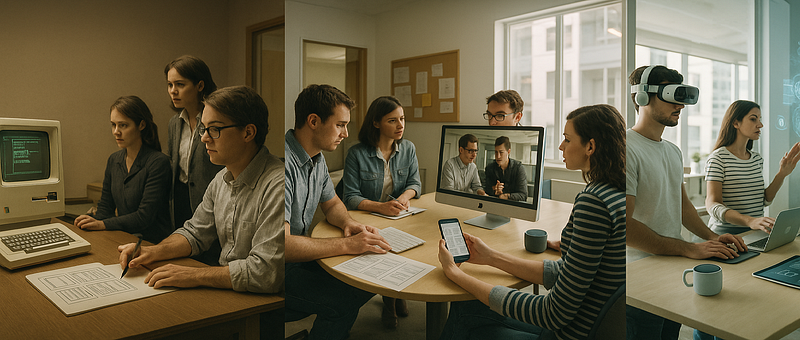
When you scroll through a job board today, “UX Designer” feels like one of the most common roles in tech. But if we step back, this profession is still relatively young. How did we get from cockpits and command lines to user journeys and AI-driven personalization?
Let’s rewind and trace the evolution of UX Design — not just as a concept, but as a job.
1940s–1960s — The Roots: Ergonomics & Human Factors
The story begins long before anyone thought about digital products. After World War II, engineers and psychologists worked on ergonomics and human factors: how people interact with machines in high-stakes environments like aviation or industrial control rooms.
These early studies laid the foundation for UX. They focused on:
- Physical comfort (controls that fit the human hand)
- Cognitive load (interfaces that reduce error in stressful situations)
- Task efficiency (making complex systems manageable)
While no one used the term “UX” yet, the essence of it — designing for humans — was already in play.
1970s–1980s — Human–Computer Interaction (HCI)
The arrival of personal computers sparked a new discipline: Human–Computer Interaction (HCI).
Key milestones of this era:
- The graphical user interface (GUI) at Xerox PARC
- Apple and Microsoft popularizing the desktop metaphor and the mouse
- Researchers defining principles of usability — how easy, intuitive, and efficient an interface should be
For the first time, the focus shifted from industrial settings to everyday users. Computers were leaving labs and offices, and design needed to make them approachable.
1990s — The Birth of “User Experience”
Enter Don Norman, a cognitive scientist at Apple. Dissatisfied with limiting the conversation to “usability,” he coined the term User Experience in the early ’90s.
Norman argued that:
- Design isn’t just about function.
- Every touchpoint shapes how a user feels about a product.
- Experience includes not only ease of use but also emotion, trust, and satisfaction.
In this decade, roles like Usability Engineer and Information Architect emerged. The job was becoming real, though not yet mainstream.
2000s — UX Becomes a Profession
With the explosion of the internet and the dot-com boom, digital experiences became business-critical:
- Companies like Microsoft, Google, and IBM formed dedicated UX teams.
- Methodologies such as User-Centered Design (UCD) and Design Thinking gained traction.
- The first wave of UX job titles appeared — designers, researchers, interaction specialists.
UX was no longer a niche practice. It was now a profession.
2010s — The App Era & Mainstream Adoption
Smartphones transformed the landscape. Suddenly, billions of people were interacting with digital products daily.
This decade established UX as one of the most sought-after roles in tech:
- Mobile apps demanded simple, intuitive, delightful interactions.
- UX teams grew, often paired with UI Designers to refine visual details.
- New specializations emerged: UX Research, Service Design, Content Design.
By the mid-2010s, no successful digital product launched without UX in the mix.
2020s — UX in the Age of AI
Today, UX goes far beyond screens. It’s about experiences across ecosystems: mobile, web, voice, wearables, AR/VR, connected devices.
New challenges have surfaced:
- Designing for trust in AI and machine learning
- Crafting transparent, ethical experiences
- Moving from interfaces to systems and services
The UX Designer is no longer just a pixel crafter — but a strategic partner shaping product vision.
Near Future (next 5–10 years)
- AI as co-designer: Tools will automate wireframes, flows, and even content. Designers will shift focus to strategy, ethics, and fine-tuning experiences.
- Invisible UX: Less about screens, more about voice, gesture, AR overlays, and contextual interactions embedded into daily life.
- Trust by design: As AI and personalization raise privacy concerns, UX will play a central role in building transparent, explainable interfaces.
- Cross-disciplinary skills: UX designers will need fluency in data, psychology, and business strategy to stay relevant.
Distant Future (20+ years)
- Post-screen design: Experiences may move into brain–computer interfaces, ambient computing, and immersive environments where interfaces almost vanish.
- Hyper-personalization: Products will adapt in real time to user mood, context, and preferences, demanding new design ethics.
- Global design equity: UX will expand beyond tech hubs, addressing accessibility, culture, and inclusivity at a planetary scale.
- Strategic leadership: UX may evolve into a discipline that shapes not just products, but societal systems — influencing policy, sustainability, and human–AI coexistence.
UX Design grew from cockpit ergonomics to a cornerstone of the digital economy in less than a century.
- The roots were in ergonomics and psychology.
- The discipline was formalized as HCI.
- The term “User Experience” was born in the ’90s.
- The job solidified in the 2000s.
- The era of apps made UX mainstream in the 2010s.
- And now, the age of AI challenges us to design for trust, ethics, and invisible systems.
The future promises an even deeper shift: from designing interfaces to designing intelligence, systems, and societies.
What started as “making machines usable” has become “crafting experiences that shape how humans and technology grow together.”
Thanks for reading — I’m on a journey to understand how AI is reshaping the way we design, build, and think about products.
I write to explore ideas, question assumptions, and spark better conversations.
What’s something this made you reflect on? I’d love to hear your perspective in the comments.
Comments (0)
Loading comments...