
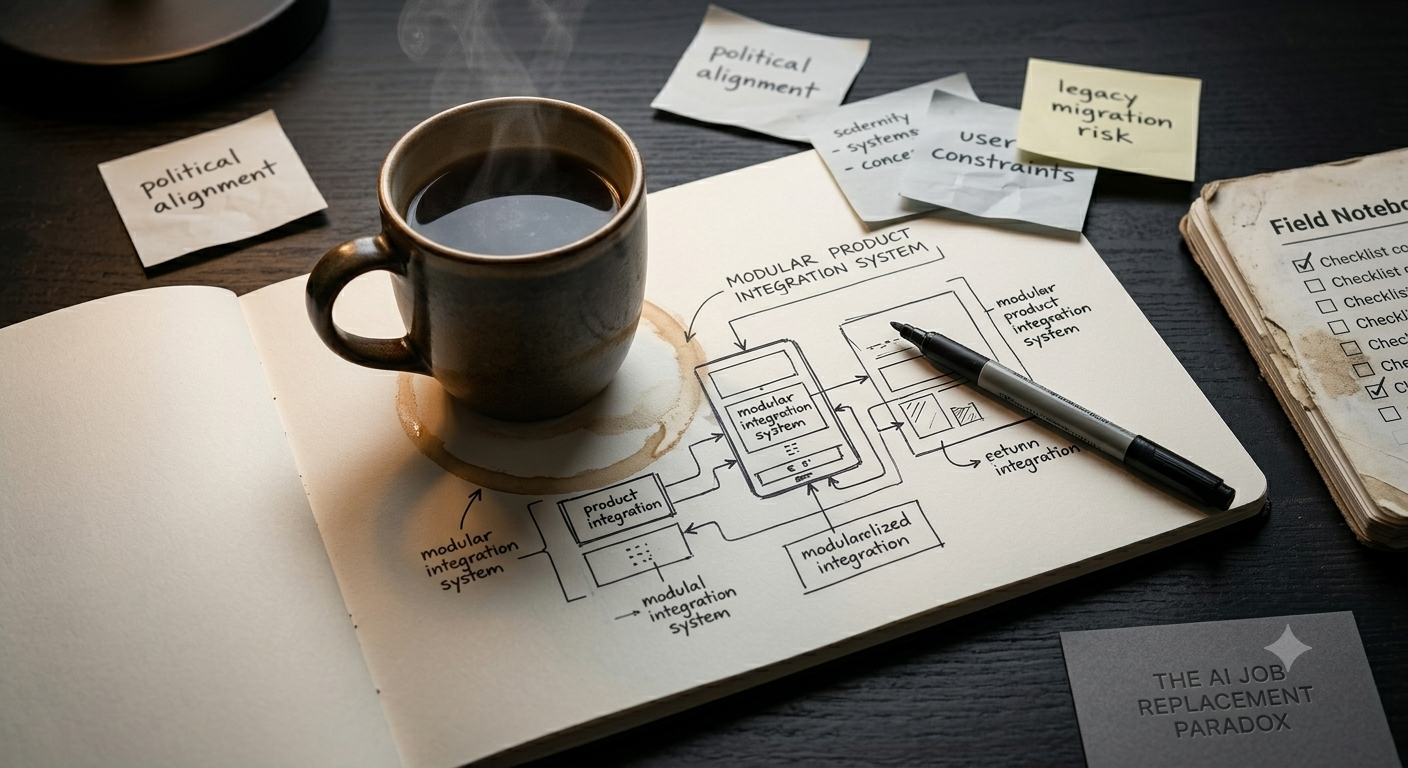
Ask any room of enterprise professionals if artificial intelligence is going to fundamentally redefine the job market over the next decade, and almost every hand will shoot upward. The macroeconomic consensus is absolute: automation is coming for the white-collar workforce. But ask those same individuals a follow-up question—whether AI will replace their specific role within the next few years—and the room falls completely silent.
The software engineer points out the sheer volume of messy legacy code and undocumented architectural debt that no large language model could decipher without throwing a recursion error. The product manager smiles, thinking of the political friction, the misalignment between engineering and marketing, and the agonizing negotiation required to ship a single feature. Even the data scientist laughs at the idea, knowing that half their job is cleaning up corrupted pipeline telemetry that breaks daily. We are living in a profound state of collective cognitive dissonance. We see automation as a tidal wave sweeping across the industry, yet we view our own desks as islands of unreplicable human complexity.
The Dunning-Kruger of Other People's Roles
This collective certainty stems from a fascinating cognitive asymmetry. We possess hyper-granular, intimate knowledge of our own daily frustrations, context, and micro-decisions. We know that our job title is a poor shorthand for the actual chaos we manage. Conversely, when we look at someone else’s job, we suffer from a structural blindness. Because we only see their final outputs—the artifact, the code commit, the spreadsheet, the wireframe—we subconsciously assume that the entire profession is merely the mechanical generation of that artifact.
Consider a classic product strategy scenario. To an outside observer, a Senior UX Designer’s job appears to be the creation of high-fidelity Figma screens and interactive prototypes. From that superficial perspective, AI tools like Midjourney, Galileo, or specialized UI generators seem like an existential threat. A non-designer looks at a prompt-to-UI tool and concludes that the entire design team can be replaced by a single manager typing instructions into a text box.
But this viewpoint confuses the container with the content. The interface is not the strategy; it is merely the physical manifestation of a hundred invisible business compromises, engineering constraints, and deep user behavioral psychological data points. The actual work happens in the messy gaps between the screens, where a system must be negotiated into existence.
The Anatomy of the Invisible Work
To understand why this paradox persists, we have to look closely at real-world product dynamics. Imagine a product leader working on a complex enterprise platform—perhaps a data integration pipeline for scientific instruments. A modern AI agent can look at the data schema and generate an optimized dashboard layout in seconds. It looks flawless. On paper, the job is done.
In reality, the human product strategist knows that the generated dashboard is completely unusable because it fails to account for a tacit, unwritten constraint: the target user group consists of laboratory operators who wear thick protective gloves and work under high-stress, low-contrast lighting conditions. Furthermore, the engineering team is currently migrating their backend architecture to a decentralized cloud environment, meaning half of the real-time data visualizations the AI dreamed up will cause massive latency issues that bankrupt the infrastructure budget.
The human designer spent three weeks mapping those constraints, drinking coffee with the cloud architect, and observing users in the field. That invisible work—the synthesis of political, technical, and physical reality—is never captured in the final Figma file. Because it is invisible, the rest of the organization doesn't realize that the AI tool hasn't replaced the designer; it has merely automated their rendering engine.
The Failure of Algorithmic Accountability
There is an even deeper reason why nobody truly believes AI can take their job: the fundamental requirement for corporate accountability. Product strategy is ultimately a series of high-stakes bets. When an organization decides to deprecate a legacy feature, pivot a product line, or bet the company's Q4 revenue on a new intelligent interface pattern, they are taking a calculated commercial risk.
An AI model can analyze historical market data and generate a beautifully articulated, high-confidence strategic recommendation. It can build the business case, forecast the ROI, and draft the product requirements. But an AI model cannot stand in front of an executive board or an assembly of angry shareholders when that strategy fails. It cannot shoulder the blame, nor can it improvise a recovery plan based on a sudden geopolitical shift or a competitor’s surprise announcement.
The Strategic Reality: Mundane task execution is being abstracted at an exponential rate. The true demarcation line on the modern corporate map is no longer between different job titles, but between those who merely execute processes and those who synthesize systemic chaos into strategic clarity.
Every professional instinctively understands that their survival depends on their ability to manage this unquantifiable risk. We know our jobs are safe from pure displacement because we are the ones who sign off on the output. We are the ones who translate raw algorithmic probability into human corporate commitment.
The Friction and the Shift
The paradox, therefore, resolves not in absolute replacement, but in an aggressive, uncomfortable shift in the friction of work. The real threat is not that a disembodied intelligence will sit at your desk and type on your keyboard. The threat is that the baseline velocity of your industry will accelerate so dramatically that your current workflow will feel prehistoric.
When artifact generation becomes virtually free—whether that artifact is a line of Python, a marketing copy deck, a financial model, or an enterprise UI layout—the value shifts entirely to orchestration, validation, and systemic curation. The professionals who lose their jobs will not be replaced by AI agents. They will be replaced by peers who recognized that their value never resided in the production of the artifact, but in the deep, highly contextual strategy that dictated why the artifact needed to exist in the first place.
The real pivot point isn’t about defending our territory from automation; it is about expanding our capacity for strategic thinking. Look closer at your own daily workflow this week—what is the invisible, chaotic friction that your current software tools can’t touch? If this perspective resonates with the subtle complexities of your own role, leave a comment below with your thoughts or hit the applause button. Let’s map out the real boundaries of human strategy together.
Comments (0)
Loading comments...