
Losing the Soul or Finding the Story?
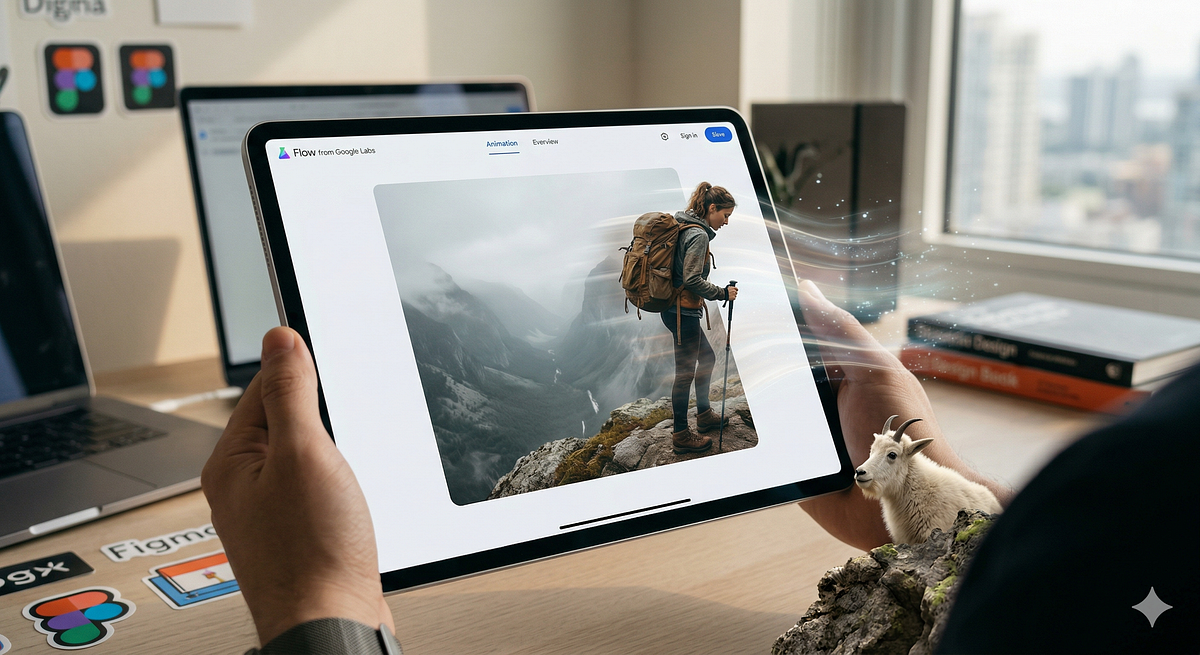
We have all faced the “Blinking Cursor Syndrome.” Whether you are a UX Designer staring at a blank Figma canvas or a Videographer facing a void-like timeline in Premiere Pro, the beginning is always the hardest part. You have a vision in your head, but the bridge between that thought and a moving, breathing story usually requires a mountain of technical labor.
Last night, that bridge became invisible. I sat down with Flow from Google Labs, and the experience felt less like “video production” and more like “digital alchemy.”
The Spark: From a Still Moment to a Moving World
I started with a single, static image. In the traditional world of content creation, that image was a dead end — a frozen moment in time. To turn that photograph into a compelling video, a videographer would typically need to embark on a grueling journey: scouring stock footage for matching b-roll, color-grading disparate clips to look cohesive, or spending hours in post-production trying to “faking” depth through complex parallax effects and masking.
With Flow, I simply gave the AI a starting point. It felt like handing a photograph to a professional director and saying, “Tell me what happens next.” The system didn’t just add “movement”; it understood the context of the scene. It looked at the pixels and recognized the difference between a breeze that should rustle leaves and a character that should look toward the horizon. For a child, this is magic — their drawing finally wakes up. For the tech guru, this is a sophisticated implementation of temporal consistency and semantic video synthesis.
The “Ping-Pong” of Creativity
The most surprising part wasn’t the motion; it was the humor. As I began to play with the storyline features, the AI started suggesting narrative beats I hadn’t even considered.
Imagine you have a picture of a traveler standing on a mountain peak. Traditional AI might just make the clouds move. Flow, however, suggests a storyline. It understands that if the traveler looks down, there should be a reason — perhaps a humorous encounter with a mountain goat or a sudden change in the weather. It adds a layer of “creative friction” — the good kind. It’s a game of catch: I throw an idea, the AI catches it, adds a witty twist, and throws it back.
This is the transition from Generative AI (where the machine just obeys a prompt) to Agentic Storytelling (where the machine collaborates on the plot). It removes the “janitorial work” of creativity. Instead of worrying about frame rates and masks, I was focusing on the punchline.
The New Economics of Narrative: Why This Is a Strategic Shift
For a UX Designer, the value of a tool like Flow isn’t just about making “cool videos.” It’s about the democratization of high-fidelity communication.
In the past, there was a massive “Experience Gap” in design. We would design a beautiful interface, but we had to describe how it felt to use it. We used arrows, boxes, and static screenshots to explain a journey. If we wanted a video to show the vision, it required a budget, a production team, and weeks of work.
Now, that “Cost of Narrative” has dropped to near zero.
- The Vision Pitch: A designer can take a single mockup of a new concept and, within minutes, generate a “Day in the Life” story.
- Rapid Validation: We can show stakeholders a 15-second “film” of a user’s emotional arc before a single line of code is written.
- Emotional Buy-in: Humans are hardcoded to respond to stories, not spreadsheets. When you can generate a narrative as easily as you can write an email, your ability to influence the product’s direction increases exponentially.
The Invisible Interface
We are entering an era where the interface between our imagination and the final result is disappearing. For the kid at home, Flow is a toy that brings their monsters to life. For the professional designer, it is a high-speed engine for strategic influence.
Google’s Flow proves that the future of video isn’t about complex timelines or professional gear. It’s about the Flow of Thought. We are no longer just editors or designers; we are directors of intelligence. The blank timeline is officially dead, and in its place is a conversation between us and the machine — one where the only limit is how fast we can think of the next chapter.
The ‘Blank Timeline’ has been a rite of passage for creators for decades. As we trade manual keyframes for AI-driven storylines, are we losing the ‘soul’ of the process, or are we finally being liberated to focus on what actually matters — the story itself? What’s your take on this shift?
Thanks for reading , I’m on a journey to understand how AI is reshaping the way we design, build, and think about products.
I write to explore ideas, question assumptions, and spark better conversations.
What’s something this made you reflect on? I’d love to hear your perspective in the comments.
Comments (0)
Loading comments...