
Context Changes Everything
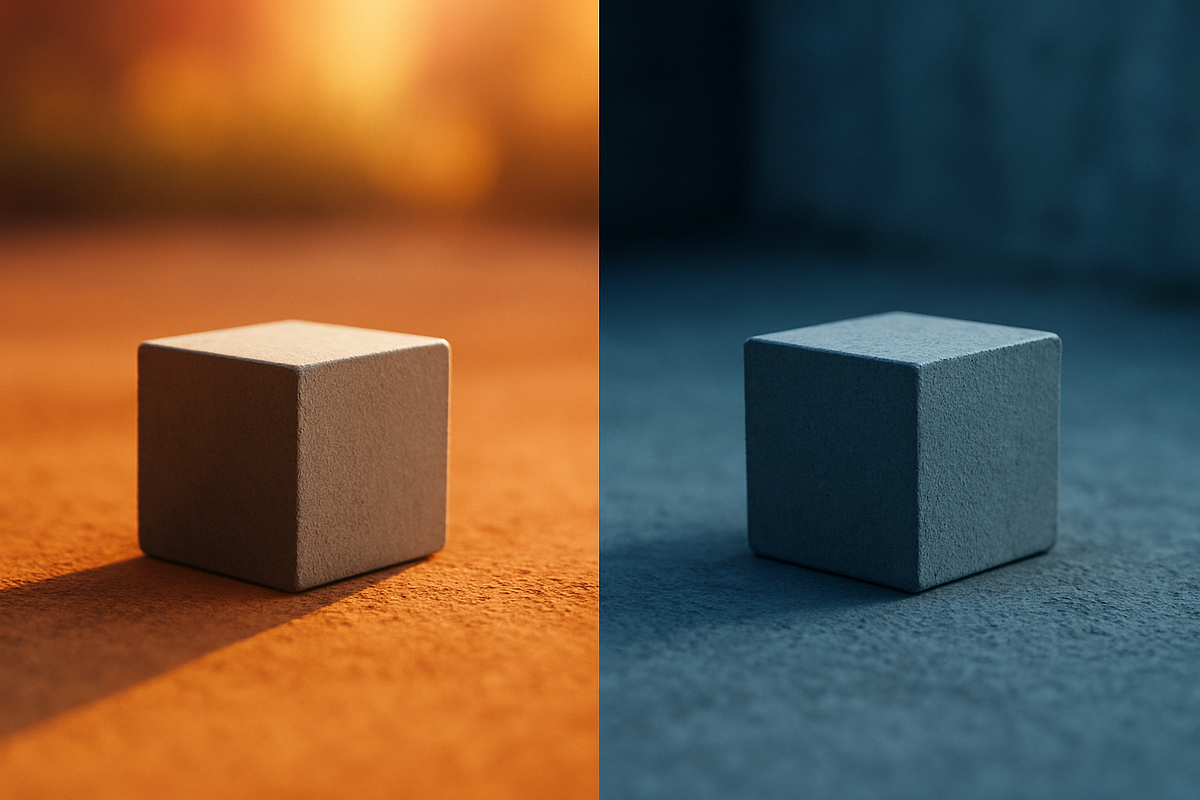
You’ve probably seen that viral illusion — two gray squares side by side, one looking lighter than the other, until someone drags them out of their backgrounds and you realize they’re identical. Same color, same shade, same pixels. The only difference was context.
It’s such a simple trick, and yet it says something profound about how we see the world. We don’t perceive things as they are — we perceive them as they appear to us, filtered through everything that surrounds them. Context isn’t just a frame; it’s part of the picture.
The Subtle Power of Context
A color feels different in shadow than in sunlight. A melody can make you cry or smile depending on the chords that follow. Even words — those precise, logical tools we rely on — can shift meaning based on when, where, and by whom they’re spoken.
Our brains are relational machines. We don’t experience things in isolation; we interpret them against the background they sit on. This is why two identical sounds can feel louder or softer depending on the room you’re in, or why a gesture that feels warm in one culture might feel invasive in another.
Perception, it turns out, is not an act of seeing. It’s an act of comparing.
Design and the Context Trap
This principle is everywhere in design. A button that looks perfectly intuitive on one interface can feel completely out of place on another. A layout that feels clean on a large monitor becomes overwhelming on a small screen. The color you thought was “neutral” suddenly screams for attention when paired with something else.
Designers often talk about contrast and hierarchy, but context is the invisible layer that binds them. You can’t judge an element without the system it lives in. A “simple” interface might actually be confusing if it hides too much. A “minimal” layout might feel cold if the product it represents needs warmth and trust.
Even AI systems fall into this trap. A chatbot saying “I understand” can feel empathetic in one moment and condescending in another. The words don’t change. The timing, tone, and context do.
When the Same Thing Feels Different
Beyond design, the world is full of context illusions.
The violinist Joshua Bell once performed in a Washington, D.C. subway station. Thousands of people passed by, barely noticing. Two nights earlier, the same man played in a concert hall where tickets cost hundreds of dollars. The performance was identical. The perception wasn’t.
Or think about the phrase “Let’s talk later.” Said with a gentle smile, it feels caring. Said over text after an argument, it feels dismissive. Same words — different emotional frame.
Even moral judgments bend to context. What one society praises, another condemns. Our sense of “good” and “bad” isn’t static; it adapts to the background noise of culture, history, and personal experience.
Reframing What We See
Understanding context doesn’t just make us better designers or communicators. It makes us more empathetic humans.
When we realize that perception depends on what surrounds it, we start questioning our assumptions. We become slower to judge and quicker to ask: What else is influencing this?
It’s a quiet but powerful shift — from seeking absolute truths to understanding relative ones.
As designer Don Norman once said, “Design is really an act of communication, which means having a deep understanding of the person with whom the designer is communicating.” That understanding always lives in context.
Seeing the Frame, Not Just the Picture
The world rarely changes as much as our perception of it does. The lighting shifts, the framing tilts, and suddenly what once felt obvious feels entirely new.
Once you start noticing this, you begin to see the hidden architecture of experience — the subtle ways background colors emotions, meanings, and choices.
Maybe truth isn’t about stripping away the background. Maybe it’s about learning to see it.
So next time you find yourself reacting to something — a design, a message, a person — pause for a moment and ask:
Is it really different? Or did the context just change?
Thanks for reading — I’m on a journey to understand how AI is reshaping the way we design, build, and think about products.
I write to explore ideas, question assumptions, and spark better conversations.
What’s something this made you reflect on? I’d love to hear your perspective in the comments.
Comments (0)
Loading comments...